
FIFA World Cup Champions : The Complete History
Introduction to the FIFA World Cup
The FIFA World Cup is the most prestigious international football tournament in the world. Organized by FIFA every four years, the competition brings together the world’s best national teams to compete for football’s most coveted trophy.
Since its inaugural tournament in 1930, the FIFA World Cup has become the world’s largest sporting event, watched by billions of fans across every continent. More than just a football competition, the World Cup celebrates sporting excellence, national pride, cultural diversity, and global unity.
Winning the FIFA World Cup represents the highest achievement in international football. Every champion earns a permanent place in football history, with legendary players, iconic matches, and unforgettable moments becoming part of the sport’s rich legacy.
For official tournament information, visit:
The History of the FIFA World Cup
The FIFA World Cup was created following the success of football at the Olympic Games. Under the leadership of FIFA President Jules Rimet, FIFA voted in 1928 to organize an independent world championship for national teams.
The first tournament was held in Uruguay in 1930 because the country was celebrating the centenary of its constitution and had won consecutive Olympic football titles. Only 13 teams participated, but the event proved to be a tremendous success and laid the foundation for what would become the world’s greatest sporting competition.
Today, the FIFA World Cup has evolved into a global festival featuring elite footballers, passionate supporters, and worldwide television audiences numbering in the billions.
Why the FIFA World Cup Is the Biggest Football Tournament
The FIFA World Cup is regarded as football’s ultimate prize because only national teams can participate, and qualification itself is extremely competitive.
Teams spend several years competing through continental qualification tournaments for the opportunity to play in the finals. Winning the World Cup requires defeating the strongest nations from every continent under immense global attention.
The tournament has also produced many of football’s greatest legends, including Pelé, Diego Maradona, Zinedine Zidane, Ronaldo Nazário, Andrés Iniesta, Lionel Messi, and many others who delivered unforgettable performances on football’s biggest stage.
The First FIFA World Cup Champions – Uruguay (1930)
The inaugural FIFA World Cup took place in Montevideo, Uruguay, in 1930.
Host nation Uruguay defeated Argentina 4-2 in the final to become the first FIFA World Cup champions. Their victory established Uruguay as one of football’s early superpowers and inspired future generations of international competition.
Although only thirteen teams competed, the tournament demonstrated that international football could capture worldwide attention and excitement.
Italy’s Consecutive Championships (1934 and 1938)
Italy became the first nation to successfully defend the FIFA World Cup.
Playing at home in 1934, Italy defeated Czechoslovakia after extra time to lift the trophy. Four years later, Italy retained the title by defeating Hungary in the 1938 final in France.
These consecutive victories established Italy as one of the dominant football nations before World War II and demonstrated the country’s tactical excellence and defensive strength.
Uruguay’s Historic Triumph in 1950
Following the interruption caused by World War II, the FIFA World Cup returned in 1950 in Brazil.
Rather than a traditional final, the tournament concluded with a decisive group-stage match between Uruguay and Brazil at the famous Maracanã Stadium. Uruguay stunned the host nation with a dramatic 2-1 victory in front of nearly 200,000 spectators.
The result became known as the “Maracanazo” and remains one of the greatest upsets in football history.
West Germany’s Miracle of Bern (1954)
The 1954 FIFA World Cup in Switzerland produced one of football’s greatest surprises.
West Germany defeated the heavily favored Hungarian team 3-2 after trailing early in the match. Hungary had entered the final unbeaten for several years and was widely expected to win comfortably.
Instead, West Germany completed one of the sport’s most remarkable comebacks in what became known as the “Miracle of Bern.”
Brazil’s Golden Era Begins (1958)
Brazil captured its first FIFA World Cup title in Sweden in 1958.
The tournament introduced the world to a remarkable 17-year-old named Pelé, whose extraordinary talent transformed international football forever.
Brazil defeated Sweden 5-2 in the final while playing exciting, attacking football that captivated audiences around the world.
This victory marked the beginning of Brazil’s rise as the most successful nation in FIFA World Cup history.
Brazil Successfully Defends the Title (1962)
Brazil successfully retained the FIFA World Cup in Chile in 1962.
Although Pelé suffered an injury early in the tournament, teammates including Garrincha delivered outstanding performances that carried Brazil to another championship.
Brazil defeated Czechoslovakia 3-1 in the final, becoming only the second nation after Italy to win consecutive FIFA World Cup titles.
England’s Historic Victory (1966)
The 1966 FIFA World Cup was hosted by England.
England defeated West Germany 4-2 after extra time in one of the most famous finals in football history. Geoff Hurst scored a historic hat-trick, the only hat-trick ever recorded in a FIFA World Cup final.
To this day, England’s triumph in 1966 remains the nation’s only FIFA World Cup championship.
Brazil Wins Its Third World Cup (1970)
The 1970 FIFA World Cup in Mexico is often regarded as one of the greatest tournaments ever played.
Brazil produced some of the finest football in history, defeating Italy 4-1 in the final. Led by Pelé, Jairzinho, Carlos Alberto, Rivellino, and Tostão, Brazil showcased beautiful attacking football that continues to inspire generations of players.
Winning their third title allowed Brazil to permanently keep the original Jules Rimet Trophy under FIFA regulations at the time.
West Germany Returns to Glory (1974)
Hosting the tournament in 1974, West Germany defeated the Netherlands 2-1 in the final.
The Dutch team, led by Johan Cruyff, introduced the revolutionary concept of “Total Football,” but West Germany’s discipline and determination secured another world championship.
This victory strengthened Germany’s reputation as one of international football’s greatest tournament teams.
Argentina Becomes World Champion (1978)
Argentina hosted the 1978 FIFA World Cup and won its first-ever championship.
The host nation defeated the Netherlands 3-1 after extra time in Buenos Aires. Led by captain Daniel Passarella and star striker Mario Kempes, Argentina thrilled home supporters by capturing the nation’s first FIFA World Cup trophy.
The victory transformed football into an even more significant part of Argentina’s national identity.
Brazil: The Most Successful FIFA World Cup Nation
Throughout the early decades of FIFA World Cup history, Brazil established itself as football’s most successful country.
By winning championships in 1958, 1962, and 1970, alongside their later successes, Brazil built a global reputation for technical brilliance, attacking creativity, and producing legendary footballers. Pelé became the only player to win three FIFA World Cup titles, cementing his place among the greatest athletes in sporting history.
Brazil’s iconic yellow jersey, attacking philosophy, and rich football culture continue to inspire millions of players and supporters around the world.
Memorable FIFA World Cup Finals
Many FIFA World Cup finals have become legendary because of their drama and significance.
The 1930 inaugural final established international football on the world stage. The 1950 Maracanazo shocked Brazil and demonstrated the unpredictable nature of the sport. England’s 1966 victory delivered one of football’s most debated goals, while Brazil’s brilliant performance in 1970 showcased some of the finest football ever played.
These championship matches helped transform the FIFA World Cup into the world’s most celebrated sporting tournament, creating memories that continue to inspire football fans decades later.
Italy Wins the 1982 FIFA World Cup
The 1982 FIFA World Cup, hosted by Spain, marked another glorious chapter in Italy’s football history. After a challenging start to the tournament, Italy produced an extraordinary turnaround that culminated in lifting their third FIFA World Cup trophy.
Led by legendary striker Paolo Rossi, Italy defeated defending champions Argentina, overcame a talented Brazilian side in one of the greatest World Cup matches ever played, and then beat Poland in the semi-finals. In the final, Italy defeated West Germany 3–1 to become world champions once again.
Paolo Rossi finished as the tournament’s top scorer and won both the Golden Boot and the Golden Ball, becoming one of the greatest heroes in Italian football history.
Argentina and Maradona’s Masterpiece (1986)
The 1986 FIFA World Cup in Mexico is forever associated with one of football’s greatest players, Diego Maradona.
Maradona produced one of the finest individual performances in World Cup history, inspiring Argentina throughout the tournament. His quarter-final against England featured both the controversial “Hand of God” goal and the remarkable “Goal of the Century,” widely regarded as one of the greatest goals ever scored.
Argentina defeated West Germany 3–2 in the final to claim their second FIFA World Cup title, with Maradona’s leadership becoming legendary.
West Germany Becomes Champions Again (1990)
Italy hosted the 1990 FIFA World Cup, where West Germany captured their third championship.
The final was a rematch of the 1986 tournament, with West Germany once again facing Argentina. This time, Germany secured a narrow 1–0 victory through Andreas Brehme’s late penalty.
The victory completed years of consistent excellence and cemented Germany’s status as one of the greatest football nations in history.
Brazil’s Fourth World Cup Title (1994)
The 1994 FIFA World Cup took place in the United States and introduced millions of new fans to international football.
Brazil reached the final against Italy, with both teams remaining scoreless after extra time. For the first time in FIFA World Cup history, the championship was decided by a penalty shootout.
Brazil emerged victorious after Roberto Baggio famously missed Italy’s decisive penalty, earning Brazil their fourth FIFA World Cup title.
France Wins on Home Soil (1998)
France hosted the 1998 FIFA World Cup and celebrated its first-ever world championship.
Led by captain Didier Deschamps and inspired by Zinedine Zidane, France defeated defending champions Brazil 3–0 in the final.
Zidane scored two memorable first-half headers, while Emmanuel Petit added a third goal late in the match. The victory united the nation and marked the beginning of one of France’s most successful football eras.
Brazil Claims Its Fifth Championship (2002)
The 2002 FIFA World Cup, jointly hosted by South Korea and Japan, witnessed Brazil becoming the first nation to win five FIFA World Cup titles.
Led by the famous attacking trio of Ronaldo, Rivaldo, and Ronaldinho, Brazil played exciting attacking football throughout the tournament.
In the final, Ronaldo scored twice against Germany, securing a 2–0 victory and completing one of football’s greatest comeback stories after recovering from serious injuries.
Brazil remains the only country to have won the FIFA World Cup five times.
Italy Triumphs in Germany (2006)
Germany hosted the 2006 FIFA World Cup, where Italy claimed their fourth championship.
Italy faced France in an unforgettable final remembered for Zinedine Zidane’s famous headbutt incident during extra time. Following a dramatic 1–1 draw, Italy won the penalty shootout 5–3.
Captain Fabio Cannavaro lifted the trophy after one of the strongest defensive performances ever seen at a FIFA World Cup.
Spain’s Historic First Title (2010)
The 2010 FIFA World Cup in South Africa became historic as Spain captured its first world championship.
Spain’s possession-based style, known as “tiki-taka,” dominated world football during this era. After defeating the Netherlands 1–0 in extra time through Andrés Iniesta’s famous winning goal, Spain completed one of the greatest periods in international football history.
Their victory followed consecutive UEFA European Championship triumphs, making Spain one of football’s greatest national teams.
Germany Wins the 2014 FIFA World Cup
Brazil hosted the 2014 FIFA World Cup, where Germany produced one of the tournament’s most memorable performances.
Germany defeated host nation Brazil 7–1 in the semi-final, one of the most astonishing results in football history.
In the final, Germany defeated Argentina 1–0 after extra time thanks to Mario Götze’s superb winning goal, earning Germany their fourth FIFA World Cup title.
Argentina and Lionel Messi Lift the Trophy (2022)
The 2022 FIFA World Cup in Qatar concluded with one of the greatest finals ever played.
Lionel Messi finally achieved his lifelong dream by leading Argentina to the FIFA World Cup championship. After a thrilling 3–3 draw against France, Argentina won the penalty shootout.
Messi’s performances throughout the tournament earned him the Golden Ball, while the final itself has been widely regarded as one of the greatest matches in football history.
Argentina’s third FIFA World Cup title completed one of the sport’s most celebrated stories.
Spain Wins the 2026 FIFA World Cup
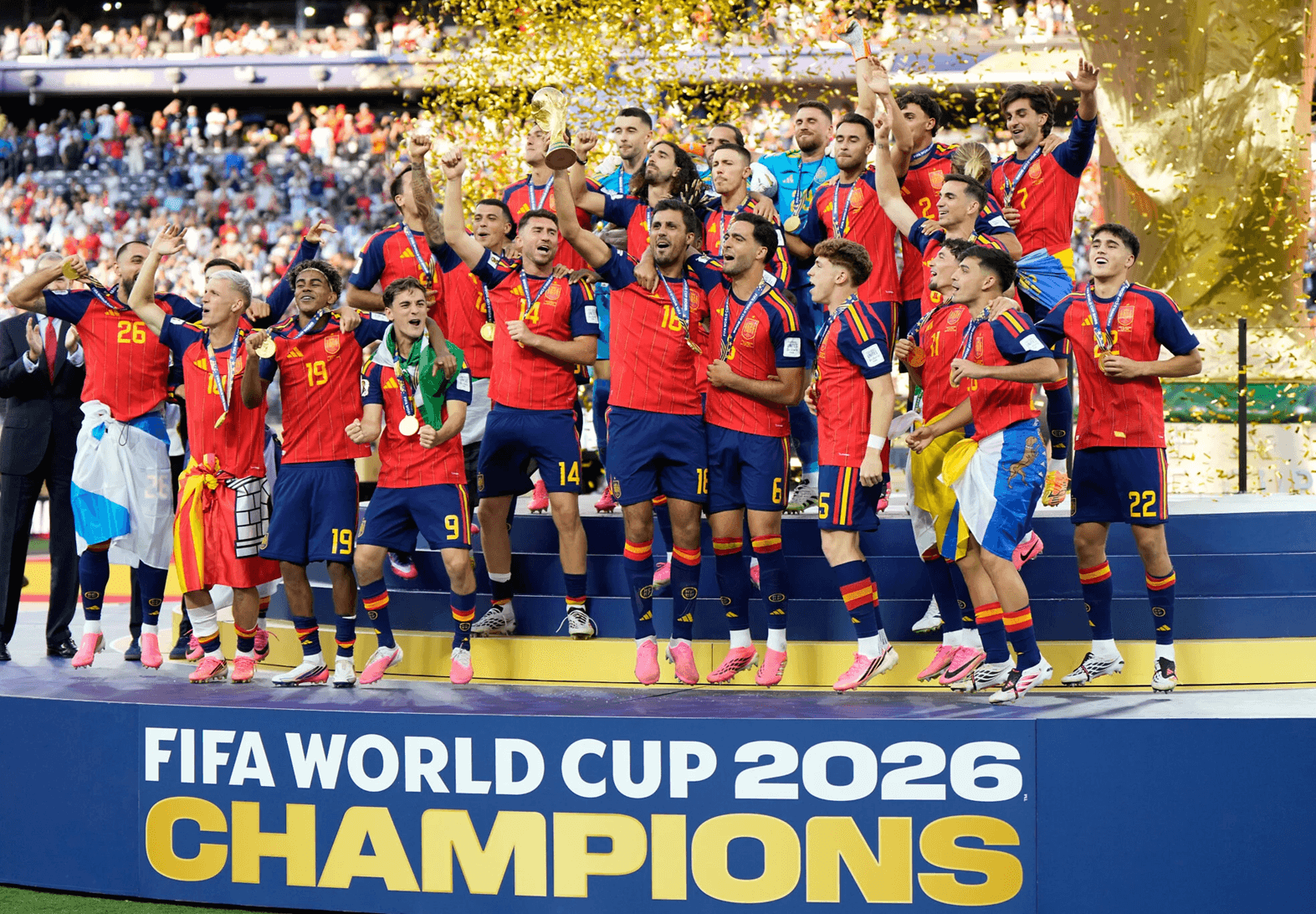
Spain captured the 2026 FIFA World Cup by defeating Argentina 1–0 after extra time in the final at New York New Jersey Stadium on 19 July 2026. Substitute Ferran Torres scored the decisive goal in the 106th minute, securing Spain’s second FIFA World Cup title after their first triumph in 2010.
Spain’s Historic Second World Cup Title
Spain entered the tournament as one of the favorites after recent international success and delivered another outstanding campaign. Their disciplined defense, intelligent possession-based football, and tactical organization under coach Luis de la Fuente proved decisive throughout the competition.
The victory made Spain the first nation to win the expanded 48-team FIFA World Cup, adding another historic milestone to Spanish football.
The 2026 FIFA World Cup Final
The final between Spain and Argentina was a tightly contested match. Spain dominated possession and created more scoring opportunities, while Argentina defended resolutely behind goalkeeper Emiliano Martínez.
After 90 minutes without a goal, the match entered extra time. In the 106th minute, Nico Williams headed a cross into the path of Ferran Torres, who fired the ball into the roof of the net to give Spain a 1–0 lead. Argentina was unable to find an equalizer, and Spain lifted the FIFA World Cup Trophy after the final whistle.
Spain’s Route to the Championship
Spain’s journey included a steady improvement as the tournament progressed. After advancing from the group stage, they defeated Austria in the Round of 32, overcame Portugal in the Round of 16, eliminated Belgium in the quarter-finals, beat France 2–0 in the semi-finals, and finally defeated defending champions Argentina in the final. Throughout the knockout rounds, Spain displayed exceptional defensive strength while continuing to control matches through possession and technical quality.
Countries with the Most FIFA World Cup Titles
Throughout FIFA World Cup history, only a select group of nations has managed to lift football’s most prestigious trophy.
Brazil leads the all-time list with five championships, followed by Germany and Italy with four each. Argentina has won three titles, while France and Uruguay have each secured two championships. England and Spain have each lifted the trophy once.
These nations have consistently produced exceptional players, world-class coaches, and unforgettable football moments that continue to shape the history of the game.
Legendary Players Who Inspired World Cup Triumphs
Many of football’s greatest legends built their reputations by leading their countries to FIFA World Cup glory.
Pelé transformed football with Brazil’s golden generation. Diego Maradona inspired Argentina through extraordinary individual brilliance. Zinedine Zidane led France to their first championship. Ronaldo became one of Brazil’s greatest goalscorers, while Lionel Messi completed his legendary career by lifting the World Cup in 2022.
These players not only won championships but also inspired millions of young footballers across the world.
How Teams Become FIFA World Cup Champions
Winning the FIFA World Cup requires years of preparation, exceptional teamwork, tactical discipline, and outstanding individual talent.
National teams must first qualify through highly competitive continental qualification tournaments before advancing to the FIFA World Cup finals. During the tournament, they compete in the group stage before progressing through knockout rounds that include the Round of 16, quarter-finals, semi-finals, and ultimately the final.
Only the team capable of consistently performing under enormous pressure earns the right to be crowned FIFA World Cup champions.
The Global Impact of Becoming World Champions
Winning the FIFA World Cup has a profound impact on players, coaches, supporters, and entire nations.
Championship victories create lifelong memories, inspire future generations, increase investment in football development, and strengthen national pride. Successful tournaments often leave lasting economic, cultural, and sporting legacies that benefit countries for decades.
For players, lifting the FIFA World Cup Trophy represents the highest honor in international football.
Conclusion
The history of the FIFA World Cup Champions is a story of excellence, determination, unforgettable matches, and legendary players. From Uruguay’s historic victory in 1930 to Argentina’s memorable triumph in 2022, every tournament has added new chapters to football’s greatest competition.
Nations such as Brazil, Germany, Italy, Argentina, France, Uruguay, England, and Spain have all earned their place among football’s elite through remarkable performances on the world’s biggest stage. Their victories have inspired billions of fans and helped make the FIFA World Cup the most celebrated sporting event on Earth.
As future tournaments continue to introduce new stars and unforgettable moments, the legacy of FIFA World Cup champions will remain one of the greatest stories in the history of sport.
For official information, statistics, and historical records, visit:
Author

Related posts

OPEC
- 0
- 5,679 words
OPEC OPEC stands for the Organization of the Petroleum Exporting Countries. It is an intergovernmental organization created by major oil-producing countries to...
Read out all
How Do I Find Reliable Wholesale Suppliers
- 0
- 9,103 words
How Do I Find Reliable Wholesale Suppliers ? Finding reliable wholesale suppliers is one of the most important tasks for anyone starting...
Read out all
What Is Happening in the World?
- 0
- 5,355 words
What Is Happening in the World? The world is currently experiencing a period of overlapping crises and opportunities. Political disputes, military conflicts,...
Read out all
BRICS
- 0
- 5,794 words
BRICS : History, Members, Economy, Goals, Expansion and Global Influence BRICS is an international grouping of major emerging economies and developing countries...
Read out all
United Kingdom
- 0
- 5,089 words
United Kingdom The United Kingdom, commonly known as the UK, is one of Europe’s most fascinating travel destinations. Officially called the United...
Read out all
Bhutan
- 0
- 4,154 words
Bhutan Travel Guide Bhutan is one of the most fascinating travel destinations in Asia, offering an extraordinary combination of Himalayan landscapes, Buddhist...
Read out all