
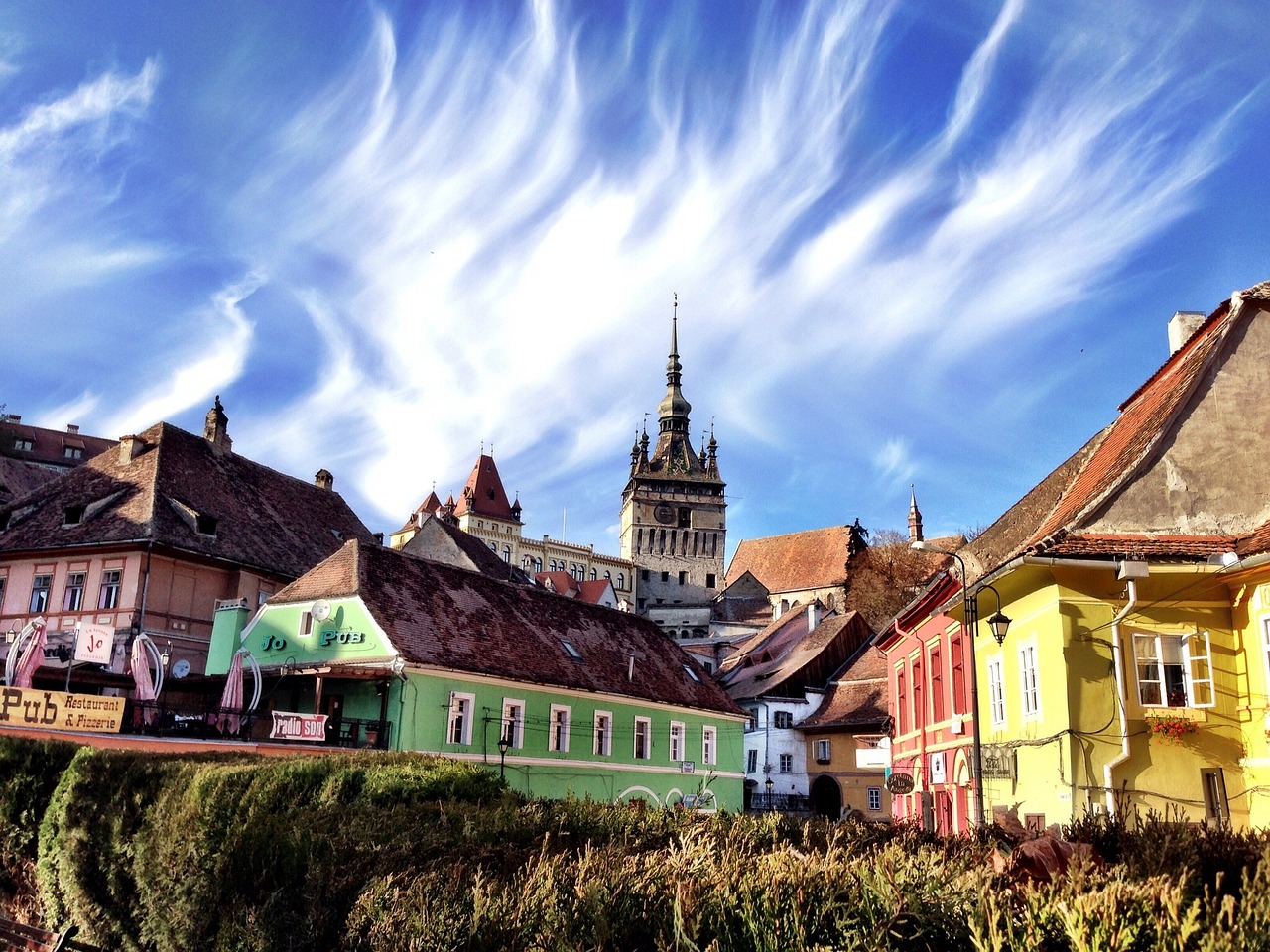
Sighișoara – Heart of Transylvania, in central Romania
Sighișoara is one of the most beautiful and well-preserved medieval towns in Europe. Located in the heart of Transylvania, in central Romania, this small yet magical place feels like a living museum. Its cobblestone streets, colorful houses, old watchtowers, and charming squares remind every visitor of the medieval world. As you walk through the historic citadel, you feel as if time has stopped and history continues to live inside every stone.
Sighișoara is famous not only for its ancient architecture but also for its atmosphere. It is peaceful, colorful, and full of character. It is also known as the birthplace of Vlad the Impaler, the ruler often connected to the Dracula legend. Today, Sighișoara is a UNESCO World Heritage Site, and travelers from around the globe come here to explore its towers, churches, museums, and narrow streets. In addition, its surrounding areas offer rolling hills, Saxon villages, fortified churches, and natural beauty.
Geography of Sighișoara
Sighișoara is located in the center of Romania, in the region of Transylvania. The town lies in the Mureș County, along the Târnava Mare River. This river flows calmly through the valley, giving the town a beautiful natural setting. The geography around Sighișoara is characterized by gentle hills, green forests, and fertile valleys. These landscapes create a peaceful environment that makes the citadel appear even more striking. It stands on top of a hill on which, in ancient times, defenders were able to see enemies approaching-the medieval citadel. The lower town spreads around this hill. Because of this arrangement, the towers of the citadel can be so easily viewed by visitors as they rise above the colorful houses of the lower town. The geography makes this town very walkable. Streets wind up the hill gently, and small paths connect the citadel with the lower areas. The Sighișoara area has a temperate climate. It has warm, pleasant summers and cold, yet beautiful winters with snow on the rooftops. The spring brings lush scenery, and autumn blankets the hills with orange and gold colors. This contributes much to the medieval beauty of the town and really gives meaning to the travel experience.
History of Sighișoara
Sighisoara has more than 800 years of history. In the 12th century, Hungarian kings invited German settlers to develop the region of Transylvania and defend it against invaders. The Saxons built a fortified settlement on a hill that would later become Sighisoara. Construction included strong walls, very tall towers, and stone houses; many of these survive to this day. Sighisoara developed into a significant craft and trading center during the 14th and 15th centuries. It had outstanding guilds: tailors, shoemakers, tanners, butchers, and goldsmiths. Each guild erected its tower along the citadel walls, used for defense. These towers gave strength to the citadel, just like they represented the pride of the town craftsmen.
One of the most important historical facts is that in Sighisoara in 1431, the highly well-known Wallachian prince Vlad the Impaler was born. His house still survives and today is a restaurant and museum. Centuries passed, and Sighisoara outlived fires, wars, and invasions. Still, this town remained wonderfully well preserved, unlike so many other medieval cities in Europe. Its survival makes it one of the best examples of a living medieval fortress. UNESCO included Sighisoara Citadel in the World Heritage list in 1999, as it is of outstanding historic value with a state of good preservation. Today, the town continues to protect its medieval character while welcoming travelers from all over the world.
Tourism Sites in Sighișoara
Sighisoara is full of attractions, and each site speaks a part of the town’s long story. Further sections describe each major tourism site in depth.
The Clock Tower (Turnul cu Ceas)
The Clock Tower is the symbol of Sighisoara, the most important landmark in the citadel, 64 meters high, and was built in the 14th century and later expanded. Its colorful tile roof, tall spire, and wooden balconies make the place seem like it has come straight from a fairy tale. The mechanism of the clock itself was very unusual, with small wooden figurines of Peace, Justice, Day, Night, and some other symbolic characters that moved every hour. Inside, this tower is the History Museum of Sighisoara. When visitors climb through several levels, each one was full of artifacts, weapons, tools, documents, and traditional clothes. At the top balcony, one would be rewarded with a panoramic view of the entire citadel, lower town, and surrounding hills.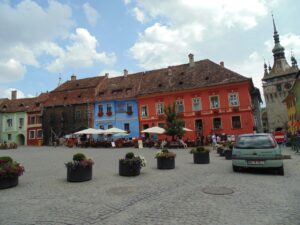
Vlad Dracul House
This yellow building near the Clock Tower is believed to be the birthplace of Vlad the Impaler. The house dates back to the early 15th century and has been carefully preserved. Today, it is a restaurant and museum.
The Covered Stairway (Scara Acoperită)
This picturesque long wooden staircase connects the lower town with the School on the Hill and dates from the 17th century. It provided shelter to students on their uphill climb to classes, shielding them from the rain and snow. Nowadays, the staircase seems to be a secret tunnel, somehow magical. Its wooden roof, narrow steps, and poor lighting make one feel as though they will enter another world while passing through. Walking through it is one of the most memorable experiences in Sighișoara.
The Church on the Hill (Biserica din Deal)
At the top of Covered Stairway stands the Hill Church, one of the most important Gothic churches in Transylvania. Beautifully constructed between the 14th and the 16th centuries with stone walls, high windows, and medieval frescoes, it also consists of an old cemetery with stone crosses, moss-grown tombs, and silent pathways.This makes it a quiet place for reflection and photography.
The Citadel Square (Piața Cetății)
This is the center of the medieval town. It is a vibrant open square, surrounded by colored historical houses, cafes, and restaurants.For centuries, this place has been a focus of life. Medieval fairs, markets, and public actions took place right here.Its atmosphere remains jolly and hospitable today. Sometimes, street musicians play here, while local artists expose handmade crafts.
The Guild Towers
The citadel once boasted 14 defensive towers, each one owned and operated by a different craft guild. A few survive to this day, including:
- The Tailors’ Tower, The Tinsmiths’ Tower, The Shoemakers’ Tower, The Butchers’ Tower, The Furriers’ Tower and The Ropemakers’ Tower
Each of them is different in shape, size, and even architectural style: some are tall and slender, while others are wide and strong. All together, they form a powerful defense system that illustrates the town’s medieval strength.
The Sighișoara Citadel Walls
The thick medieval walls of the citadel surrounding it show how well the town was fortified. A walk along these walls gives visitors a wonderful sense of history. Pathways between towers lead to peaceful corners, garden areas, and lookout points.
Surrounding Places of Sighișoara
The surroundings of Sighișoara are impregnated with old villages, rolling hills, fortified churches, and quiet landscapes, still preserving the authentic Transylvanian charm. As travelers go outwards from the medieval citadel, they will soon learn that beauty does not stop at the city walls; each village nearby tells a new story, a fresh cultural layer, and yet another chance to travel back in time.
Biertan
One of the most remarkable nearby places is Biertan, located about thirty kilometers from Sighișoara. As visitors approach the village, they immediately notice its massive fortified church rising above the small houses. Travelers usually enjoy wandering around, taking photographs, and listening to the stories of the local people who are always proud to share the history of their town. Because Biertan is surrounded by soft hills, it also offers beautiful viewpoints where visitors can enjoy wide landscapes filled with vineyards and forests.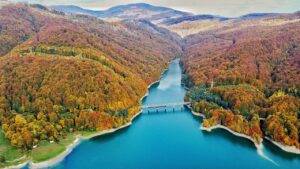
Viscri
Another fascinating surrounding place is Viscri, a small village admired worldwide for its simplicity and preserved architecture. Viscri became internationally famous after King Charles III (when he was still Prince of Wales) restored a traditional house there. As a result, the village saw a revival of crafts, ecological farming, and sustainable tourism. The village’s fortified church, a UNESCO World Heritage Site, stands proudly at its center.
Saschiz
Travelling a bit farther, visitors reach the picturesque village of Saschiz, a place known for its tall fortified church and its medieval ruin tower on a nearby hill. Because Saschiz lies along the old road connecting Brașov and Sighișoara, it has historically been an important settlement. Today, it is appreciated for its natural beauty and local food products, such as organic jams, honey, and syrups.
Cloasterf
Another beautiful surrounding place is Cloasterf, a quiet Saxon village hidden among the fields and meadows. Although smaller and lesser-known, Cloasterf retains a charm that appeals especially to travelers seeking silence and authenticity.Simple houses with red-tiled roofs line the streets, and the fortified church remains the heart of the community. The village is ideal for long walks, cycling tours, and birdwatching because many rare species thrive in the untouched countryside.Visitors often appreciate the peacefulness, finding it a lovely escape from busy city life.
Malancrav
Not far from Sighișoara, travelers also find Malancrav, another village deeply rooted in Saxon traditions. Malancrav is special because a large percentage of its population has preserved the old Saxon culture even after many others left the region. The Apafi Mansion, an elegant restored residence, stands as a symbol of the village’s rich past.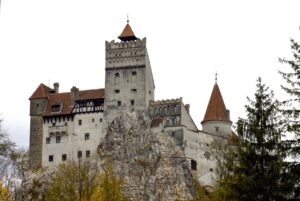
Rupea
While exploring the surroundings of Sighișoara, visitors often travel to Rupea, a town known for its dramatic hilltop fortress. The Rupea Fortress can be seen from the road because it rises sharply above the landscape. Once inside, travelers walk through multiple walls and courtyards, each level telling a different chapter of the region’s history. From the top, the panorama of rolling hills and distant villages is breathtaking. Because of its strong historical atmosphere, Rupea is often included in day trips from Sighișoara, offering a perfect combination of culture, history, and scenery.
Transylvanian Highlands
Travelers who enjoy nature often continue to the Transylvanian Highlands, a large protected area surrounding many villages near Sighișoara.The region is filled with meadows, oak forests, limestone formations, and quiet footpaths where visitors can explore untouched ecosystems. This region is ideal for hiking, photography, horse riding, and eco-friendly tourism.Wildflowers bloom in abundance during spring and summer, creating wonderfully colorful fields that make the journey even more enjoyable.
Odorheiu Secuiesc
Another excellent surrounding place is Odorheiu Secuiesc, a larger town located a bit farther from Sighișoara. Although it is not a Saxon village, it represents the Székely Hungarian culture that is strong in this part of Romania. The town features historic buildings, lively cafés, local markets, and cultural festivals. Its surrounding villages include beautiful wooden churches, traditional rural houses, and small craft workshops. Because it combines history with a modern lifestyle, Odorheiu Secuiesc offers travelers a different but equally interesting perspective of Transylvania.
Bran Castle
For visitors interested in legends, Bran Castle, often called “Dracula’s Castle,” lies within a reasonable distance from Sighișoara. Although it is not extremely close, many travelers choose to include it in their Transylvanian tour. The castle, surrounded by forests and mountains, rises dramatically above a valley and provides a mix of history and mythology.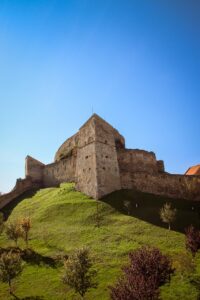
Brașov
Meanwhile, Brașov, one of Romania’s most vibrant cities, lies to the south and serves as a major gateway to the Carpathian Mountains. Visitors from Sighișoara often travel there to explore medieval squares, Gothic churches, and mountain viewpoints. Brașov combines old-world charm with modern comforts, offering restaurants, museums, theatres, and lively pedestrian streets.Nearby, the peaks of the Postăvarul Mountains create excellent opportunities for nature lovers who enjoy hiking or winter sports.
Hârtibaciu Valley
Travelers seeking a quieter environment often continue to the Hârtibaciu Valley, a wide rural area stretching between Sibiu and Sighișoara. The valley contains numerous hidden villages, traditional farms, fortified churches, and endless fields. Because the valley is sparsely populated, it remains one of the most peaceful places in Romania.
Sibiu
one of the most impressive places near Sighișoara is the city of Sibiu, known for its elegant squares, cultural festivals, and large open-air museum. Sibiu lies a bit farther from Sighișoara, but its rich German-influenced architecture and vibrant energy make it a popular addition to any regional itinerary. The surroundings of Sighișoara create a wide and captivating world filled with history, natural beauty, and deep cultural traditions. Each nearby village or town tells its own story, and together they form one of the richest cultural landscapes in Europe. Whether travelers seek ancient fortifications, peaceful countryside roads, or lively regional towns, the area around Sighișoara offers something truly special.
Best Time to Visit Sighișoara
The best time to visit Sighișoara is from May to October, when the weather is warm and pleasant. Spring and summer bring blooming flowers, open-air festivals, and long daylight hours. Autumn is also wonderful, with peaceful streets and colorful forest scenery. Winter is cold but magical, especially if snow covers the citadel.
How to Go to Sighișoara
- By Train: Sighișoara has a railway station with connections from Bucharest, Brașov, Cluj-Napoca, and Târgu Mureș. Train travel is convenient and scenic.
- By Car: You can drive from nearby cities. Roads are smooth, and the views are beautiful, especially through villages and forests.
- By Bus: Buses and minibuses connect it with the surrounding towns. The cheapest option is by bus or minibus.

Conclusion
Sighișoara is one of Europe’s most magical medieval towns. Its colorful buildings, stone streets, tall towers, and historic charm make it feel like a real-life storybook. The citadel is perfectly preserved, and every corner has a story. Whether exploring the Clock Tower, climbing the Covered Stairway, or relaxing in the Citadel Square, visitors feel a strong connection to the past. Surrounding villages and fortified churches offer even more beauty and history. With its peaceful environment, rich culture, and welcoming people, Sighișoara is a destination that stays in the heart long after the journey ends.
Author

sadikhan.ceo@gmail.com
Related posts
Doha Travel Guide
- 0
- 2,147 words
Doha Travel Guide – A Modern Arabian City with Culture and Luxury Doha is quickly becoming one of the hottest places to visit...
Read out all
Lisbon Travel Guide
- 0
- 2,266 words
Lisbon Travel Guide – A Beautiful Coastal Capital with Culture and Value Lisbon pops up on pretty much every list of Europe’s...
Read out all
Prague Travel Guide
- 0
- 2,455 words
Prague Travel Guide – A Magical European Destination Full of History and Charm If you’re dreaming of a city that looks and...
Read out all
Berlin Travel
- 0
- 2,097 words
Berlin Travel Guide – A City of History, Culture, and Modern Energy Berlin isn’t your typical European capital—it buzzes with history and...
Read out all
Amsterdam Travel Guide
- 0
- 2,602 words
Amsterdam Travel Guide – A City of Canals, Culture, and Timeless Beauty Honestly, Amsterdam is one of those cities that just grabs...
Read out all
Barcelona, Spain
- 0
- 2,340 words
Barcelona, Spain Travel Guide – A Vibrant Mediterranean City Barcelona feels alive, no matter what time of year you show up. The...
Read out all