
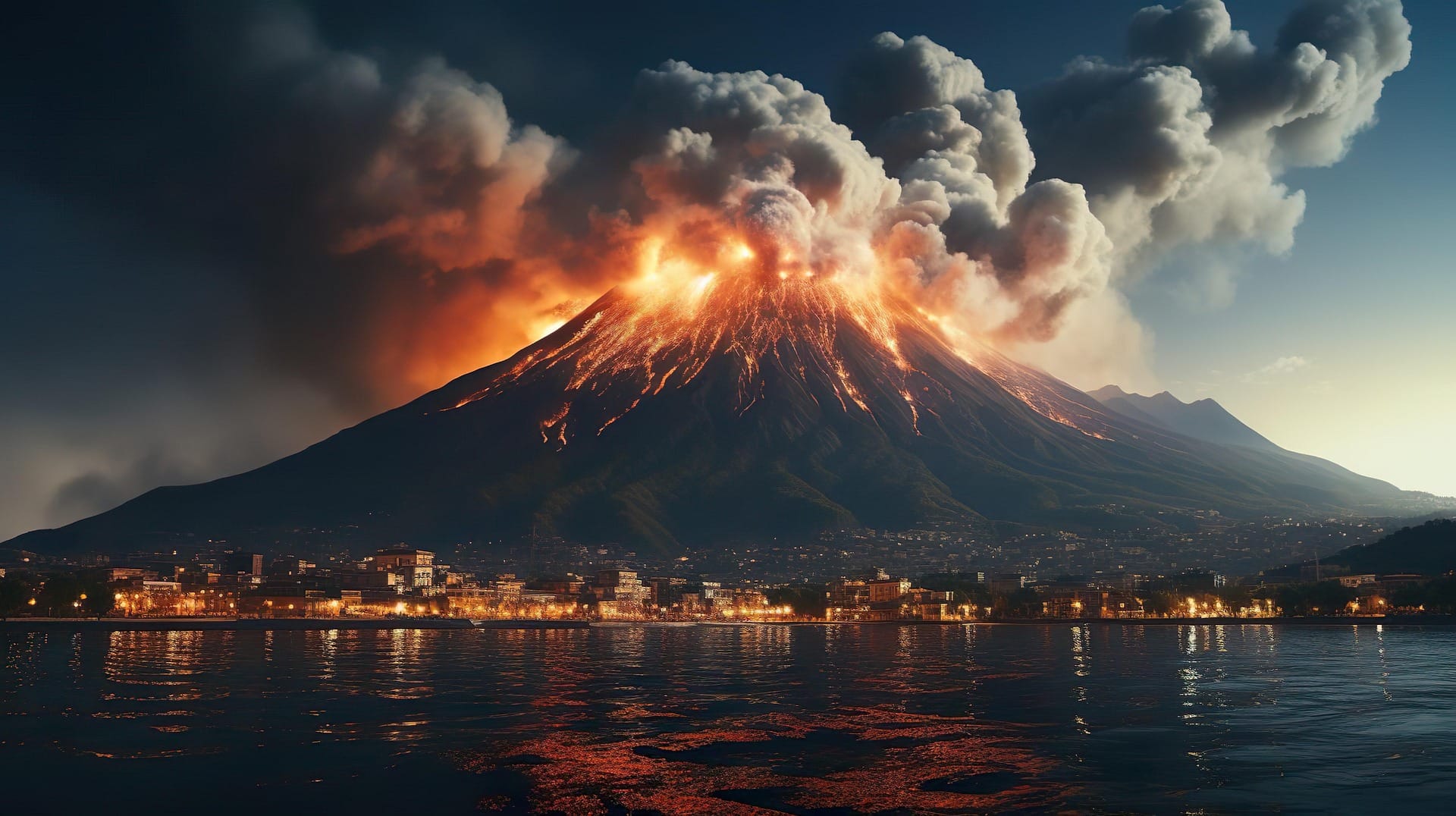
Volcanoes Around the World🌋
Volcanoes are some of Earth’s most powerful natural features. They rise high above the land. They build mountains, islands, valleys, and even entire countries. When a volcano erupts, it reveals the awe-inspiring force of Earth. When it rests, it may seem like a quiet giant. Indeed, many people go to volcanoes for geological lessons, to have adventures, or just to gaze in wonder. In this extensive article, we shall review some of the largest volcanoes in the world according to their size, shape, history, importance, and other places around them. I am writing in a straightforward manner, using simple words, short sentences, and clear transitions. I will even provide extensive information regarding the surroundings where these volcanoes occur for better understanding of their uniqueness.
Mauna Loa – Hawaii, USA
Mauna Loa is Earth’s largest volcano in volume. It is located on Hawaii’s Big Island. Its height from the seafloor is greater than Mount Everest’s. Mauna Loa rises from deep beneath the Pacific Ocean. If measured from its base under water, it reaches more than 9,000 meters tall. Mauna Loa is a shield volcano. This means it has gentle slopes. It usually has non-explosive eruptions. Instead, it releases slow, flowing lava. The lava spreads far and covers wide areas. Because of this, Mauna Loa has grown very big over millions of years.
Surrounding Places Near Mauna Loa
Around Mauna Loa, there are many interesting places. First, there is Hawaii Volcanoes National Park: this park protects a large part of the volcano. It has many hiking trails, lava tubes, steam vents, and viewpoints. Visitors can walk across old lava flows. The park also includes Kilauea, a smaller but very active volcano nearby.
Second, there is Hilo town. It is situated on the eastern side of the island. Hilo has beautiful gardens, waterfalls, and black-sand beaches. It is often rainy, but that makes the area green and fresh.
Third, there is Kona, on the western side. Kona is sunny and dry. It has resorts, coffee farms, and snorkeling spots. People who come to see Mauna Loa usually stay in Kona because of the comfortable weather. In addition, there are also Mauna Kea observatories, which are not very far from Mauna Loa. Mauna Kea is another big volcano, but it is used mainly for astronomical purposes. From there, one can view the stars more clearly than in virtually any place in the world. The area surrounding Mauna Loa has a lot of natural scenery, towns, and even scientific centers. So, it is one of the best volcanic regions on Earth.
Tamu Massif – Pacific Ocean
Tamu Massif is an oceanic giant shield volcano. It lies in the northwest Pacific Ocean, and it is considered by many scientists as one of the largest volcanoes ever found. It might even be the largest single volcano on Earth by surface area, according to some. Tamu Massif is largely submerged. The volcano formed around 145 million years ago. As it is submerged beneath the water, it cannot be visited; therefore, scientists research it using ships and underwater mapping.
Surrounding Locations
Since Tamu Massif lies underwater, most of the surrounding places are ocean regions. The nearest landmasses are:
- Japan (to the west), Mariana Islands, to the south, Micronesia (to the southeast)
The ocean that surrounds Tamu Massif is very deep. Marine life is rich, as coral ecosystems and many different species of fish thrive. Deep-sea mountains, ridges, and trenches exist close by. Even though tourists cannot go to Tamu Massif, according to researchers, the area is important for understanding Earth’s geological history.
Mount Kilimanjaro – Tanzania, Africa
Mount Kilimanjaro is the highest mountain in Africa, the peak rising 5,895 meters above sea level. Kilimanjaro is not one volcano but a volcanic complex with three cones: Kibo, Mawenzi, and Shira. Kibo is the highest and is considered dormant. Mawenzi and Shira are extinct. Kilimanjaro is one of the largest volcanoes in volume because of its broad shape and tall height.
Surrounding Places Near Kilimanjaro
There are many interesting places around Kilimanjaro. First, there is Kilimanjaro National Park. The park protects the mountain and its wildlife. People visit the park to climb the mountain. There are several climbing routes. Each route has forests, valleys, and open plains.
Second, there is Moshi town. Moshi sits at the base of the mountain. It is a friendly town with coffee farms, markets, and cafes. Many climbers stay in Moshi before commencing their hike.
Third, there is Arusha, a larger city west of Kilimanjaro. Arusha is a city known as the gateway to safaris. From Arusha, visitors can go to Serengeti National Park, Ngorongoro Crater, and Tarangire National Park. Next, there are villages of Chagga people on the lower slopes. Chagga people grow bananas, coffee, and vegetables. Their culture is rich. Visitors can explore their traditional homes and farms. So Kilimanjaro is more than a volcano; it’s a cultural and natural region with wildlife, farming, and adventure.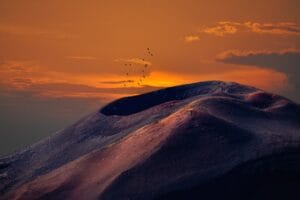
Mount Fuji – Japan
Mount Fuji is one of the most famous volcanoes in the world. It is a stratovolcano with a perfect cone shape. It stands at 3,776 meters. Mount Fuji is the tallest mountain in Japan. Fuji has erupted many times throughout history. Its last major eruption was in the early 1700s. Today, scientists consider it active but quiet.
Surrounding Places Near Mount Fuji
The environs around Mount Fuji are filled with attractions. First, there is the Fuji Five Lakes region. These lakes are Kawaguchiko, Saiko, Yamanakako, Shojiko, and Motosuko. They sit near the northern slopes. The area has hotels, campgrounds, museums, and viewpoints. The second is Hakone. Hakone is famous for its hot springs, mountains, and Lake Ashi, from where Mount Fuji can be viewed in all its beauty.
Third is Fujinomiya and Gotemba. These towns are usually the entry points toward the climb of Mount Fuji. They have commercial areas, shrines, and other cultural sites. Fourth, there is Aokigahara Forest, also called the Sea of Trees. It lies at the base of Fuji. The forest has hiking trails, caves, and unique plants. The surrounding areas make Mt. Fuji not only a volcano but also a major travel destination.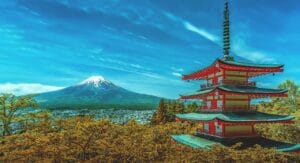
Mount Etna – Sicily, Italy
Mount Etna is one of the world’s most active volcanoes. It is also one of the largest in Europe. It rises about 3,357 meters above sea level, but its height changes after eruptions. Etna has frequent eruptions. Some eruptions produce lava fountains. Some send ash into the sky. Because of this, Etna shapes the land around it all the time.
Surrounding Places Near Mount Etna
There are many beautiful places around Etna. First of all, there is Catania, a big city at the foot of the volcano. Catania has baroque buildings, markets, and beaches. The city is lively, full of culture. Second, there is the famous hilltop town of Taormina. It has ancient theaters, beaches, and luxury hotels. From Taormina, Etna could be clearly seen. Third, there are Etna vineyards. Around Etna, because of volcanic activity, the soil has a lot of minerals. Winemakers grow grapes here and produce famous wines. So, Mount Etna is not only a natural giant but also a center of culture, food, and tourism in Sicily.
Mount Vesuvius – Italy
Mount Vesuvius is famous for its eruption in AD 79. This eruption destroyed the Roman cities of Pompeii and Herculaneum. Today, Vesuvius is one of the most studied volcanoes. It rises about 1,281 meters. It’s not the biggest in height, though it is one of the most important throughout history.
Surrounding Places Near Vesuvius
The area round Vesuvius is full of history. First, there are the ruins of Pompeii. Pompeii shows ancient Roman life frozen in time: houses, streets, theaters, and baths are well preserved. The other ancient city covered with the volcanic materials is Herculaneum; it contains wooden structures, frescoes, and artifacts. Third, there is Naples; the major Italian city has museums, castles, and famous pizza restaurants. Fourthly, natural beauty is added by the Bay of Naples: from many points around the bay, people are able to see Vesuvius rising above the landscape. This volcano is unique because it combines history and beauty.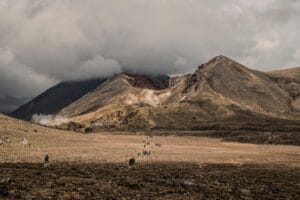
Mount St. Helens – Washington, USA
Mount St. Helens gained world recognition following its 1980 eruption. This eruption tore off the top of the mountain, revealing an immense amount of ash, landslides, and devastation; today, the mountain is 2,550 meters high.
Surrounding Places Near Mount St. Helens
The area around St. Helens is very varied. First is Mount St. Helens National Volcanic Monument, which protects the volcano and the area affected by the 1980 eruption. The monument allows visitors to view the crater, blast zone, and recovering forests. Second, there is Spirit Lake, which was changed by the eruption; it has floating logs and strong reflections of the mountain. Third, towns like Castle Rock, Woodland and Vancouver offer access, restaurants, and tours. Fourth, the nearby Gifford Pinchot National Forest has deep forests, rivers, and wildlife.
Popocatépetl – Mexico
Popocatépetl is the second-highest volcano in Mexico at 5,426 meters and one of the most active volcanoes on the North American continent.
Surrounding Places
First, there is Puebla with its large town and colonial architecture. Then there is the town of Amecameca at the foot, which boasts markets and culture. Third, there is another volcano nearby called Iztaccihuatl. Another important one is Paso de Cortés, a viewpoint between the two volcanoes.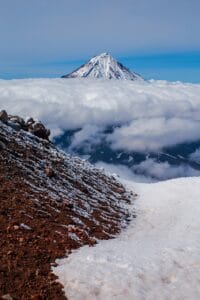
Ojos del Salado – Chile/Argentina
The world’s highest active volcano is Ojos del Salado. It is 6,893 meters high.
Surrounding Places
First, there is the Atacama Desert, which is the driest place on Earth. There are salt flats, lagoons, and volcanic plateaus. The nearby towns include Copiapó in Chile and Fiambalá in Argentina.
Mount Elbrus – Russia
Elbrus is a dormant volcano and at 5,642 meters is the highest peak in Europe.
Surrounding Places
Elbrus is surrounded by the Caucasus Mountains. Towns such as Terskol and Nalchik support tourism. There are nearby skiing resorts, valleys, and rivers.
Cotopaxi – Ecuador
Cotopaxi is a high and symmetrical volcano. It stands at 5,897 meters.
Surrounding Places
Wildlife is protected by the Cotopaxi National Park. The cities of Latacunga and Quito are nearby. It has lakes, grasslands, and forests.
Mount Ruapehu – New Zealand
Ruapehu is the biggest active volcano in New Zealand.
Surrounding Places
It is surrounded by the UNESCO site of Tongariro National Park. The nearby towns are Ohakune and Turangi. There are ski resorts and crater lakes.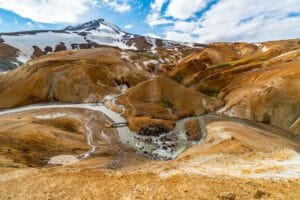
Mount Erebus – Antarctica
Erebus is the southernmost active volcano on Earth, with a lava lake at its summit.
Surrounding Places
It includes Ross Island, McMurdo Station, and ice fields. The volcano is enveloped by penguins, seals, and snowy landscapes.
Mount Pinatubo – Philippines
Pinatubo erupted in 1991 and caused global climate effects.
Surrounding Places
Cities include Angeles, San Fernando, and Olongapo. It contains ash fields, lakes, and hiking trails.
Nyiragongo – Congo (DRC)
Nyiragongo hosts a very large lava lake.
Surrounding Places
Close by is Goma city. It is surrounded by the Virunga National Park. It offers gorilla trekking, a major attraction.
Sakurajima – Japan
Sakurajima is one of Japan’s most active volcanoes. It rises from the sea near Kagoshima Bay. Its eruptions are frequent but generally not very large.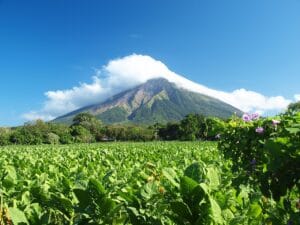
Surrounding Places
- Kagoshima City: a large city near the volcano, featuring hot springs, museums, and shopping.
- Sakurajima Ferry: Tourists take ferries to get close to the volcano.
- Hot Springs: Many natural hot springs offer views of the volcano.
- Arimura Lava Observatory: Provides safe viewing points for eruptions.
Mount Rainier – Washington, USA
Mount Rainier is a large stratovolcano that rises to 4,392 meters. It is heavily glaciated and dominates the surrounding landscape.
Surrounding Places
- Mount Rainier National Park-offering hiking, camping, and wildlife watching.
- The visitor centers at Paradise and Sunrise provide panoramic views and trail access.
- Nearby Towns: Ashford, Enumclaw, and Tacoma are considered to be the gateways for climbers and tourists.
- Mt Rainier ski areas: famous because of winter sports.
Teide – Tenerife, Canary Islands, Spain
Teide is the highest peak in Spain, reaching 3,718 meters; it is also a volcano, so that makes Tenerife a volcanic island.
Surrounding Places
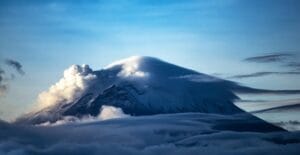
- Teide National Park: a UNESCO World Heritage Site with trails, viewpoints, and volcanic landscapes.
- Cable Car Station: Allows visitors to reach near the summit.
- Nearby towns, which include La Orotava and Puerto de la Cruz, have colonial architecture with hotels.
Mount Merapi – Indonesia
Mount Merapi is one of Indonesia’s most active volcanoes, and its eruptions are explosive and dangerous.
Surrounding Places
- Yogyakarta City: Cultural city with temples and museums, near Merapi.
- Selo and Kaliurang Villages serve as gateway villages for climbing Merapi.
- Merapi National Park: Offers trekking and nature tours.
- Prambanan Temple: Ancient site not too far from the volcano, under UNESCO protection.
Mount Bromo – Indonesia
Bromo is well known for its distinctive shape and active crater; it’s part of the Tengger Semeru National Park.
Surrounding Places
- Probolinggo City: Access point to Mount Bromo.
- Sea of Sand (Laut Pasir): A wide plain of volcanic ash surrounding the volcano.
- Cemoro Lawang Village: Known for sunrise tours and mountain views.
- Close to Semeru Volcano: The highest volcano in Java and also part of the park.
Mount Pelee – Martinique, Caribbean
Mount Pelee is known for the devastating 1902 eruption that destroyed Saint-Pierre.
Surrounding Places
- Saint-Pierre Town: town rebuilt with historical museums about the eruption.
- Caribbean Beaches: At close proximity to Mount Pelee are scenic beaches.
- Hiking Trails: Trails to the summit pass through tropical forests.
- Volcanological observatories monitor volcanic activity.
A Quick Overview of Different Volcanic Giants
| Volcano Type | Largest Example | Location |
|---|---|---|
| Shield Volcano | Mauna Loa | Hawaii |
| Supervolcano | Yellowstone | USA |
| Underwater Volcano | Tāmu Massif | Pacific Ocean |
| Stratovolcano | Mount Fuji | Japan |
| Highest Active Volcano | Ojos del Salado | Chile–Argentina |
| Tallest Free-Standing Volcano | Kilimanjaro | Tanzania |
Volcano Tourism Activities
Hiking & Climbing
Most volcanoes have trails, and some trails lead to the crater. For instance, Mount Kilimanjaro has several routes, while Mount Fuji has climbing paths opened in summer, and Mount Bromo has sunrise trails.
National Parks
Volcanoes are often in national parks. Examples:
- Mauna Loa & Kilauea: Hawaii Volcanoes National Park
- Mount Rainier: Mount Rainier National Park
- Mount Teide: Teide National Park. Parks offer visitor centers, guided tours, camping, and wildlife viewing.
Lava & Crater Viewing
Active volcanoes, such as Etna, Nyiragongo, and Stromboli, permit safe viewing of their flows, many from observatories or guided tours. Nighttime tours are available offering spectacular views.
Cultural Tourism
Many volcanoes are of cultural importance:
- Popocatépetl and Iztaccihuatl: Mexican legends
- Mount Fuji: Sacred in Shinto religion
- Mount Kilimanjaro: Chagga culture and coffee farms
Adventure Sports
- Some volcanoes provide: Skiing: Ruapehu, Etna, Teide; Paragliding: Mount Bromo, Teide Rafting & climbing (Villarica) Photography & Nature Watching

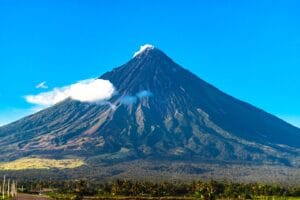
Why Volcanoes are important
- They Form New Land Volcanoes create islands, such as Hawaii and Iceland. They Produce Fertile Soil Volcanic soil supports farming.
- They attract tourism. Millions travel to the volcanoes every year. They Illustrate Earth’s Internal Energy Volcanoes help us understand how the planet works.
Conclution
There are lots of big volcanoes on Earth. Some rise from the ocean floor. Some stand alone on land. Some sleep for thousands of years. Others erupt often. But each volcano tells a story. Together, they show the beauty, danger and complexity of nature. From the long lava flows of Mauna Loa, to the hidden powers beneath Yellowstone, to the perfect shape of Fuji and snow-crowned Kilimanjaro, the largest volcanoes remind us that our world is dynamic. Each of these great volcanoes has forests, towns, lakes, cultures, and parks nearby. These places around the volcano are part of the volcanic story. Volcanoes shape life, they shape land, they shape history, and they will continue shaping our planet for millions of years to come.
Author

Related posts
Best Places to Visit in Dinant
- 0
- 4,779 words
Best Places to Visit in Dinant, Belgium Dinant is one of the most beautiful small towns in Belgium and one of the...
Read out all
Best Places to Visit in Mont-Saint-Michel
- 0
- 4,964 words
Best Places to Visit in Mont-Saint-Michel , France Mont-Saint-Michel is one of the most extraordinary destinations in France and one of the...
Read out all
UNGA
- 0
- 5,649 words
UNGA (United Nations General Assembly ) The United Nations General Assembly, commonly known as the UN General Assembly or UNGA, is one...
Read out all
Best Places to Visit in Kathmandu
- 0
- 4,089 words
Best Places to Visit in Kathmandu , Nepal Kathmandu, the capital of Nepal, is one of South Asia’s most fascinating travel destinations....
Read out all
Best Places to Visit in Vilnius
- 0
- 5,246 words
Best Places to Visit in Vilnius , Lithuania Vilnius, the capital of Lithuania, is one of the most fascinating destinations in the...
Read out all
Best Places to Visit in Riga
- 0
- 6,005 words
Best Places to Visit in Riga , Latvia Riga, the capital of Latvia, is one of the most fascinating destinations in the...
Read out all